



Written by
Ariane Baer-Harper
Head of School in the USA. Experienced School Leader including positions as Superintendent, Associate Head and Director of Global Engagement. @abaerharper
Years ago, I presented at the International Baccalaureate African Festival in Johannesburg on the topic of understanding the role cultural understanding plays in school leadership. This subject, one that I am passionate about, started when I discovered Hofestede Insights and his country comparison tool. After spending countless hours comparing the countries I had worked in with the United States, I realized how ingrained our values are in how we approach education and leadership. Often, leaders are not aware of how these values are roadmaps for schools to meet and achieve their mission. They serve as directions in our school culture to remind us that we are on the right path. School leaders have the responsibility to recognize that not all of us will have the same roadmap and, much like a GPS will offer more than one option to get to where we need to go, there are different pathways to reach a destination. Although we are working towards the same mission in our schools, the way we get there may be different. The first step in acknowledging that our paths may differ is to encourage everyone on our teams to start the journey, to begin with.
Antoine St. Exupéry, the famed author of Le Petit Prince, described values-driven leadership in the following way:
If you want to build a ship, don’t drum up people to collect wood and don’t assign them tasks and work, but rather teach them to long for the endless immensity of the sea.
Antoine St. Exupéry
How, as leaders, do we get our staff to yearn for the endless immensity of the sea so that, while we may start at different times and go down different paths, we trust that we will reconnect along the way toward our common destination? In all my years in leadership professional development, and thinking of all management tools I have learned, I can simply (or not so simply!) say, that it starts with leading with the heart. Those of you who are familiar with the Heart, Head, Hand leadership model, know that before we put in place metrics around performance and feedback we need to have people buy-in to the mission (heart), which needs to be clear for everyone. As we are all working towards the same goals and objectives, is the why clear to everyone, and beyond that, has leadership recognized that the why will not be the same for everyone?
Creating a culture of buy-in is imperative for schools to work cohesively as people move in their own way, at their own pace, and on the path that responds best to their values. Our mistake as school leaders is to think that buy-in happens organically. If an idea sounds good to us, then it should sound good to everyone, right? We think we have identified the why and if we share it then everyone is on board. Oftentimes, this is not such an illogical way of thinking. The problem lies in our assumptions. Even if the mission and vision are strong and you are an excellent leader who has no problem conveying the why to your staff, leaders need to take the time to get individual buy-in because performance and engagement are directly linked with a sense of belonging. When you take the time to get everyone’s buy-in it communicates a very important message to your team. It tells them: you matter to me and you belong.
When staff feels valued and recognized miracles can happen in schools. So, if we understand that we need to get buy-in, then why are school leaders not taking more time to get this buy-in?
I believe it is linked to three things:
1. Assuming that buy-in is already occurring
2. Not understanding what a game-changer buy-in can be for achieving optimal
performance
3. Not having taken the time to understand the values, especially cultural values, of each one of your employees so that we can understand what makes them thrive.
When we take time to do number three, we communicate to our team that they matter, and that we value them and care for them. We start to create a culture of collaboration, and our vision and mission statement which defines where we are going is important to everyone. When everyone cares about accomplishing goals, people start finding their own innovative ways to start and get there. Everyone bringing their own innovative ideas to accomplish our vision doesn’t change the mission, it just changes how each one of us gets there. When people yearn for the sea, they all want to build the boat, even if they each contribute a different skill and idea to how to build the boat, even if the way they add their value is different. This is where leading with heart to understand these values is critical to the success of your organization.
Why is understanding values and culture so important in all of this? For me, it all comes down to creating a safe space where employees will want to start taking initiative, and will easily have buy-in because they feel seen and heard. This is very hard to do, even if you have the best intentions, if you don’t, as a leader, understand a culture’s values. This is why I became so interested in delving into Hofestede’s work. I’ll take, as an example, Senegal, where I led for almost ten years. It is a culture that values community over individualism (the opposite of the United States, which is my native culture.) If you look at Hofestede’s country comparison chart below, the USA in purple ranks 91 in individualism compared to 25 in blue for Senegal.
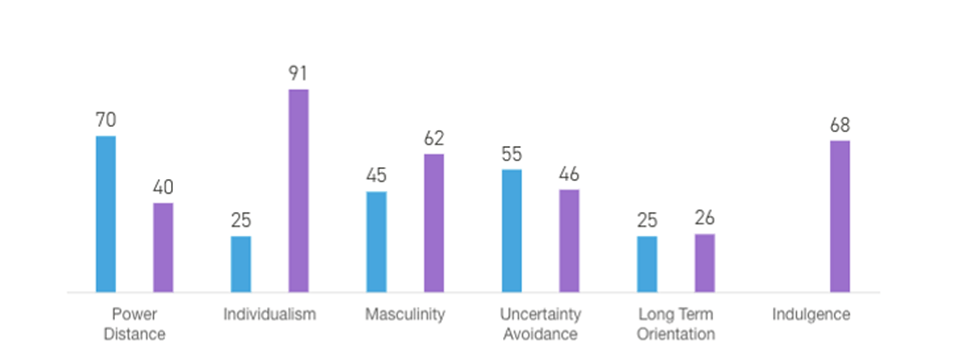
If your employees come from a society that values community over individualism, they will not feel comfortable taking initiative. They may even fear that it will be frowned upon by others from the same culture. If we don’t understand this, then as leaders we might get frustrated by the lack of progress we see around us, never fully understanding that this has more to do about cultural values than a lack of desire to work towards the vision. We have a responsibility as international leaders to understand the role culture plays in our schools, and once we understand its importance, we can create a school culture that inspires everyone to bring their best skills to the group, regardless of how different these skills might be.
If we think back to the quote by St. Exupéry, there is not one right way to build a boat, and so as a leader, we should not be giving out instructions on how to build a boat. We should tell our team, “This is where we are going together (mission and vision), and this is why we need to build a boat (buy-in). I trust you all to help get us there. Now show me what you’ve got.” This is what it truly means to lead with heart.


Leave a comment